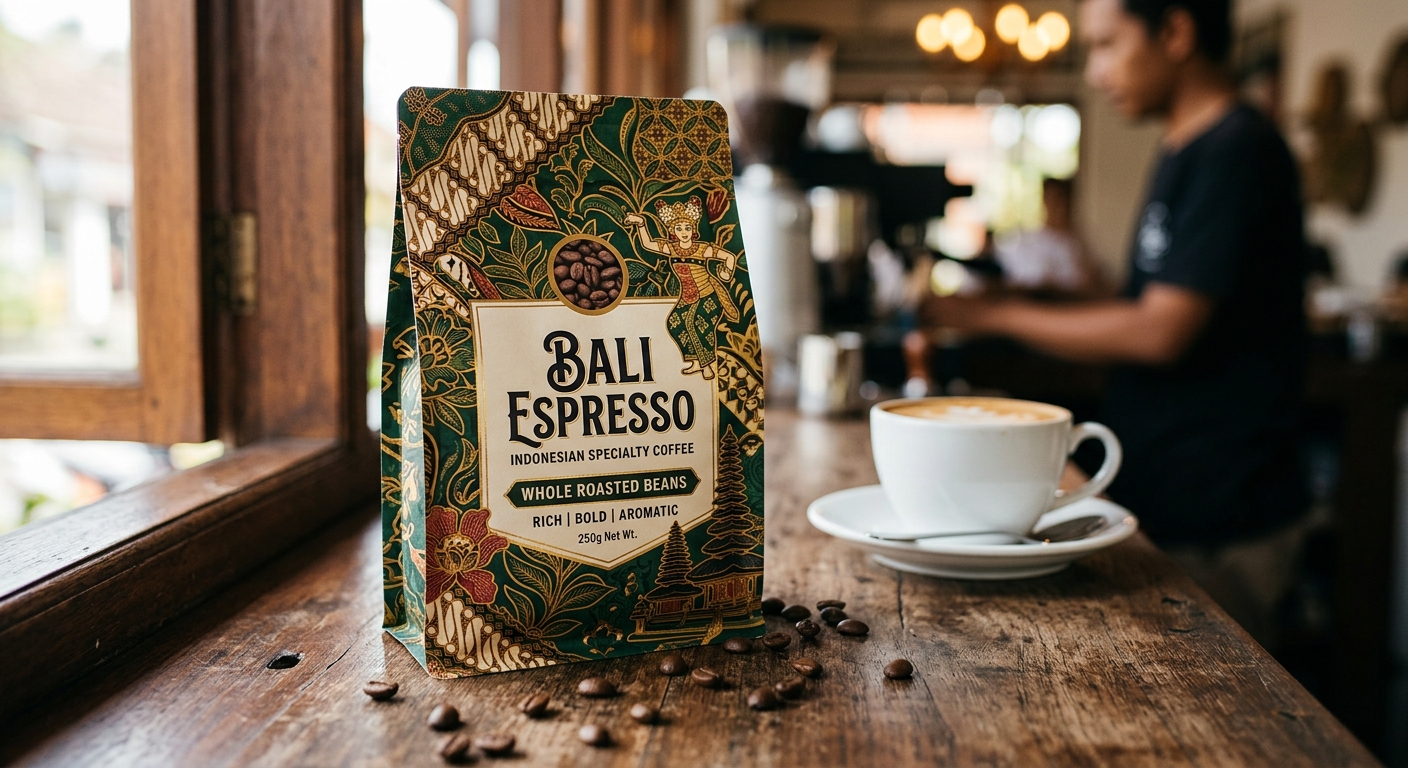
Walk into most specialty coffee shops and the single origins on the shelf tell the same story: Ethiopia, Kenya, Colombia, maybe a Guatemala. Those are extraordinary coffees. They are also the coffees every roaster is bidding on. When we started Bali Espresso, we asked a different question - not 'what scores highest at auction' but 'what do we actually have a relationship with' - and the answer was the Indonesian archipelago, three islands, three completely different cups.
Kintamani, from the volcanic highlands of Bali above Lake Batur, is our flagship for a reason. Fully washed and dried on raised beds, it is clean and syrupy with a black-cherry brightness sitting over a dark-chocolate base. It defies the lazy assumption that Indonesian coffee is all heavy and earthy. Grown at 1,400 meters in mineral-rich volcanic soil, it has the structure to shine as a pour-over and the body to hold up on espresso.
Toraja, from the Sulawesi highlands, is the opposite personality and we love it for that. Wet-hulled the traditional way - giling basah - it lands low and resonant: cedar, dark maple, a savory herbal edge. That heavy body is exactly what punches through steamed milk, which is why we dial most wholesale espresso programs around it. It is the coffee that made us believe process matters as much as origin.
Mandailing, from Sumatra, is where we get to have fun. We take a classic Sumatran and ferment it anaerobically for seventy-two hours before hulling, and it goes loud - overripe tropical fruit crashing into raw cacao, with just enough controlled funk to make people ask what they are drinking. It is the lot our subscribers request by name, and the one that changes minds about what Sumatran coffee can be.
Sourcing these coffees is not a spreadsheet exercise. We buy from a cluster of independent smallholders and washing stations, we pay well above the commodity price, and twice a year we fly the supply chain in reverse to stand in the rows where it grows. The distance between a volcano in Bali and an espresso bar in Wynwood is about nine thousand miles and roughly six weeks. Keeping that line honest is the entire job.
